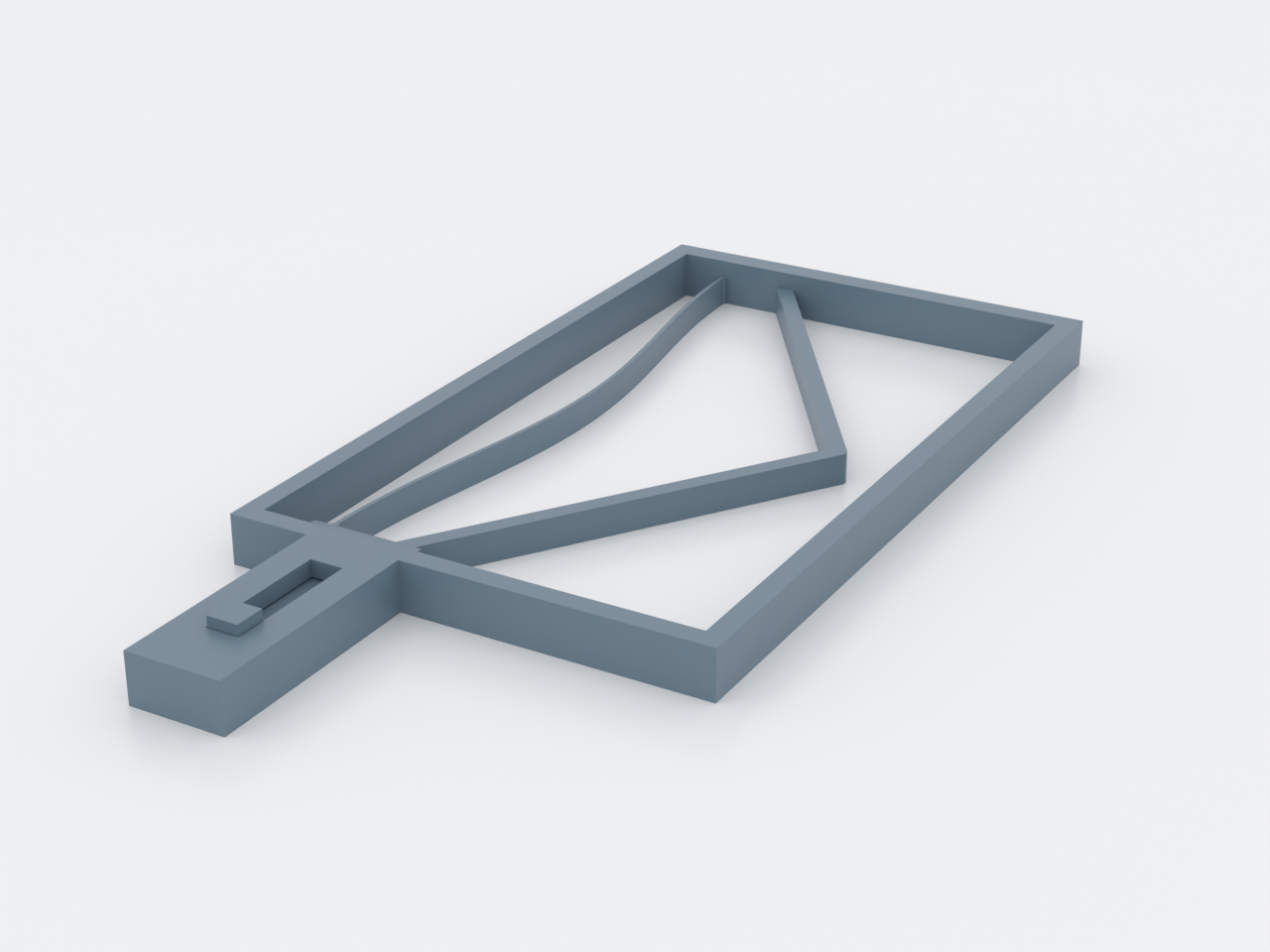

A one-piece captive slider that glides at a near-constant ~2 N across its whole 20 mm stroke instead of fighting a rising spring — a quasi-zero- stiffness mechanism: a pre-buckled arch (negative stiffness) and a chevron V-beam (positive stiffness) in parallel, sized so their slopes cancel. Push the knob; it moves like a good drawer slide, not a spring. Printed in place, no supports, no assembly.
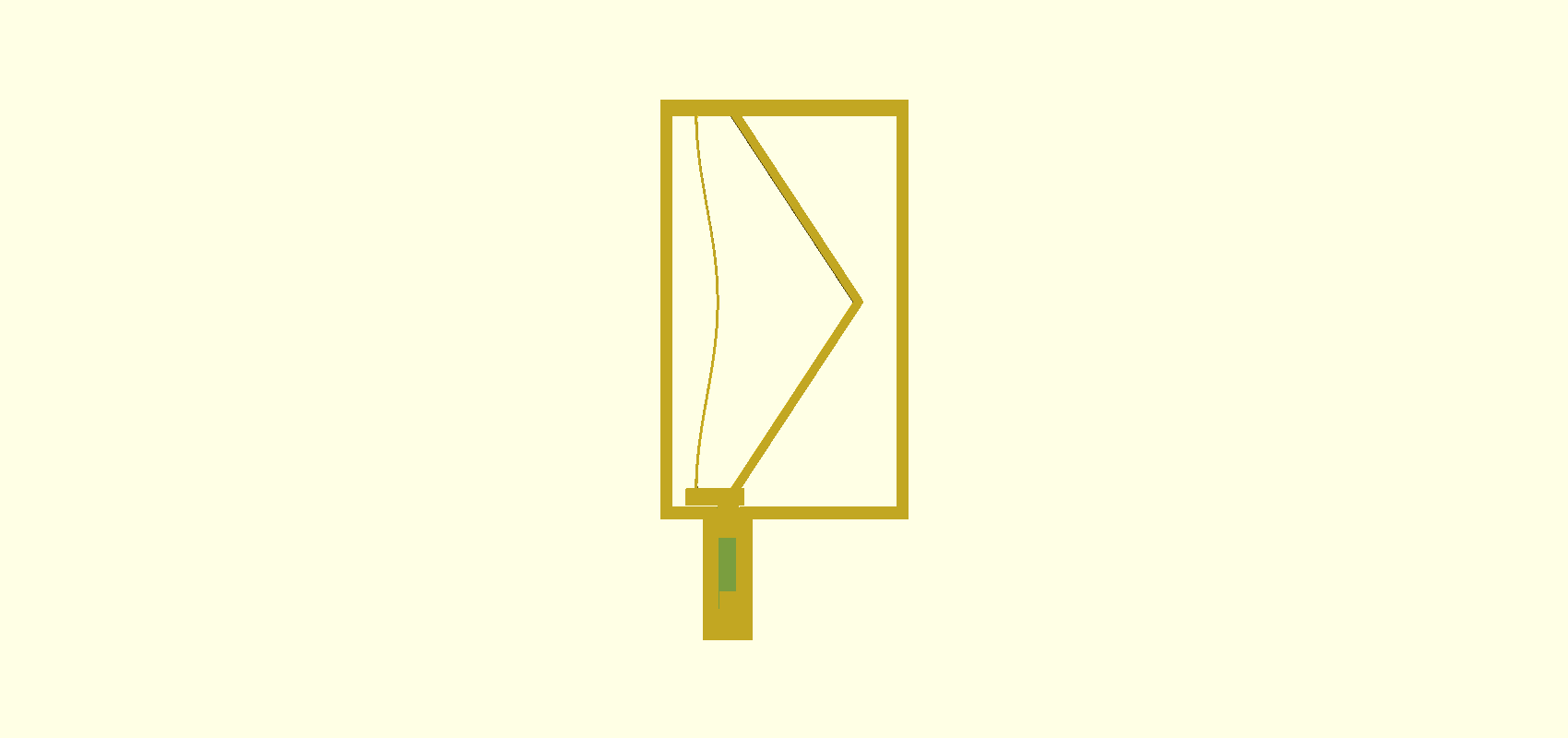
Top-down over the whole mechanism — the guided slot at left, the spring chamber at right: the pre-buckled arch bows −X from its chord while the chevron opens +X, both anchored between the same head and far bar:
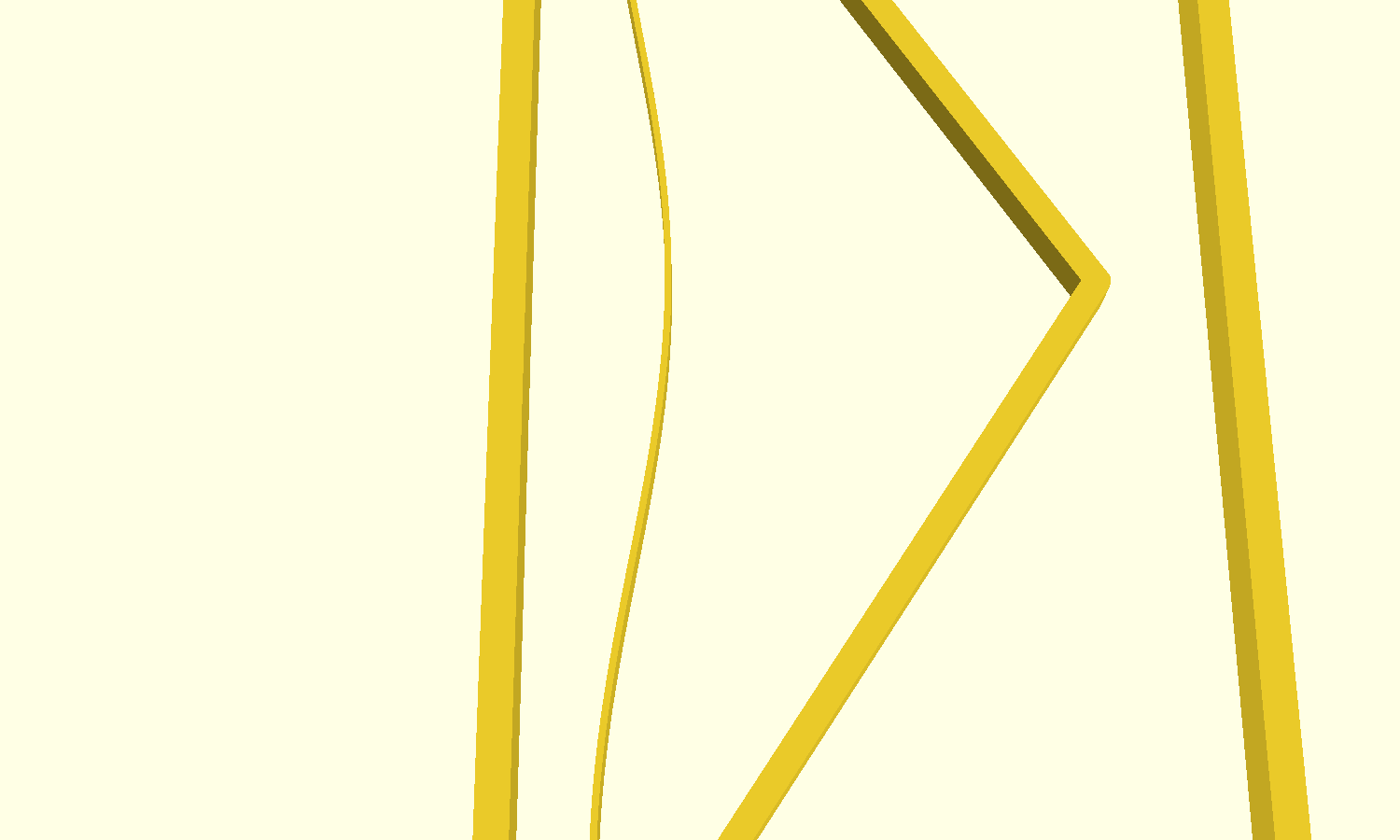
Mid-span close-up — the arch band and the V legs crossing paths without touching, with the sweep clearances to the chamber walls:
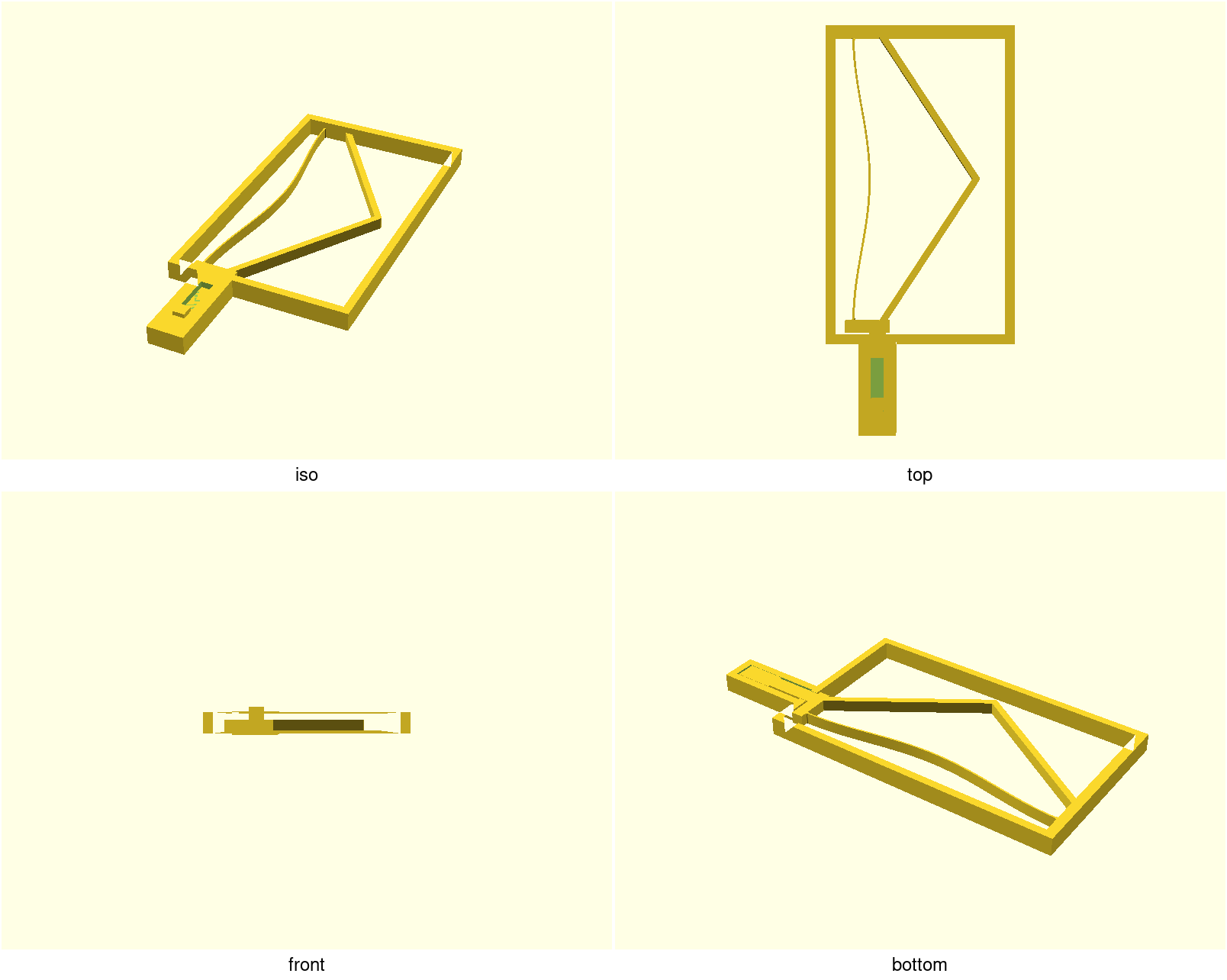
The print-this-first coupon — three fit cells (the k_xy = 0.40/0.45/0.50 sweep, cell 2 is production) and the ~9 N feeler cell:
What you get
czs-slider— the mechanism, one piece, ~200 × 93 × 12 mmczs-slider-coupon— print this first: three slider-fit cells plus a feeler cell (~9 N plateau) to tune the fit and check your printer's spring character before the ~5 h main print
Print settings
- Material: PETG (a live flexure — not PLA; PP or nylon also work)
- Layer height: 0.20 mm
- Infill: 15–20%; the frame is solid-walled, the springs are solid
- Supports: none — the model prints flat and the only bridge is the 10.4 mm capture deck over the slider channel
- Orientation: as drawn, profile on the bed; every flexure bends in the layer plane
- Bed: ~200 × 93 mm footprint (one axis ≥ 210 mm); elephant-foot compensation on — the sliding gaps sit at z = 0
- First motion: the slider lightly micro-welds to its roof when printed; the first push shears it. Expected, not a defect.
Parameters
The ones worth touching (all in czs-slider.scad, Customizer-grouped):
| Parameter | Default | What it does |
|---|---|---|
k_xy | 0.45 | Sliding-fit spread factor — the tuning knob. Coupon cells 1/2/3 sweep 0.40/0.45/0.50; welded → up a cell, rattles → down |
z_layers | 2 | Roof gap in whole layers (sag budget over the slider) — raise to 3 only if the deck welds |
target_force | 2.0 N | Plateau level; the geometry re-solves around it |
stroke | 20 mm | Travel; the flat zone is the middle 70% |
demo_u | 0 mm | Preview pose only — print at 0 |
Everything else is derived: the arch (t, h, span, switch force) from the
bistable-toggle (#389) nondimensional solve, the V-beam (leg thickness,
apex) from matching the arch's negative slope at the flat-zone ends,
clearances from the process constants (nozzle_d, layer_h). NOTES.md
has the full chain and the predicted force–stroke curve.
Assembly & use
None — it prints assembled. Push the knob through the deck slot: the glide
you feel is the mechanism (arch force falling, chevron force rising, sum
flat). It holds ~1 N of preload at rest against the back stop and arrives
firmly at the far stop. Tune the fit with the coupon first; if the plateau
character is off on your spool (a hard ramp means your PETG runs stiffer
than the 2000 MPa datum), the coupon's feeler cell tells you which way —
see "Print this first" in NOTES.md.