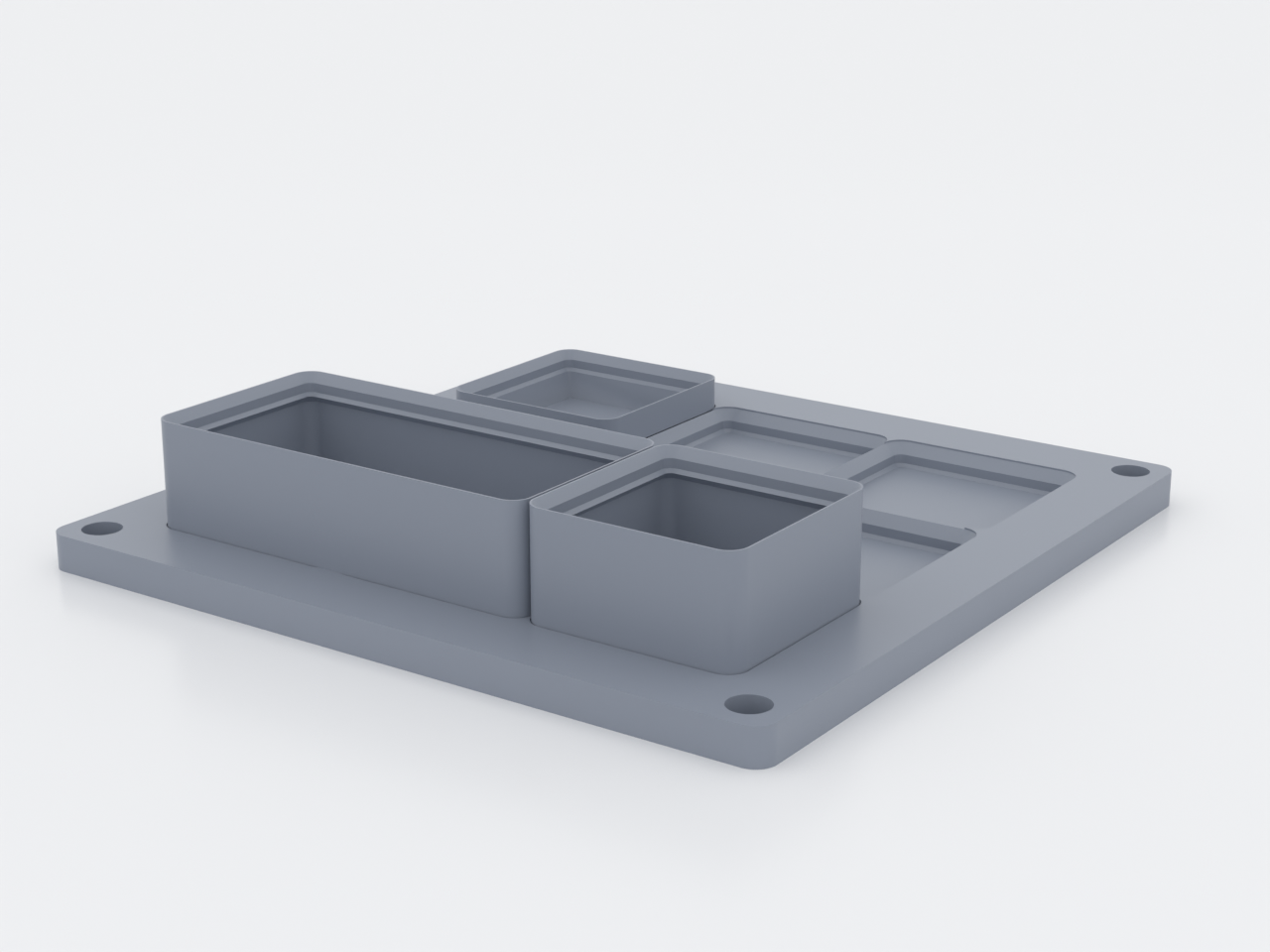
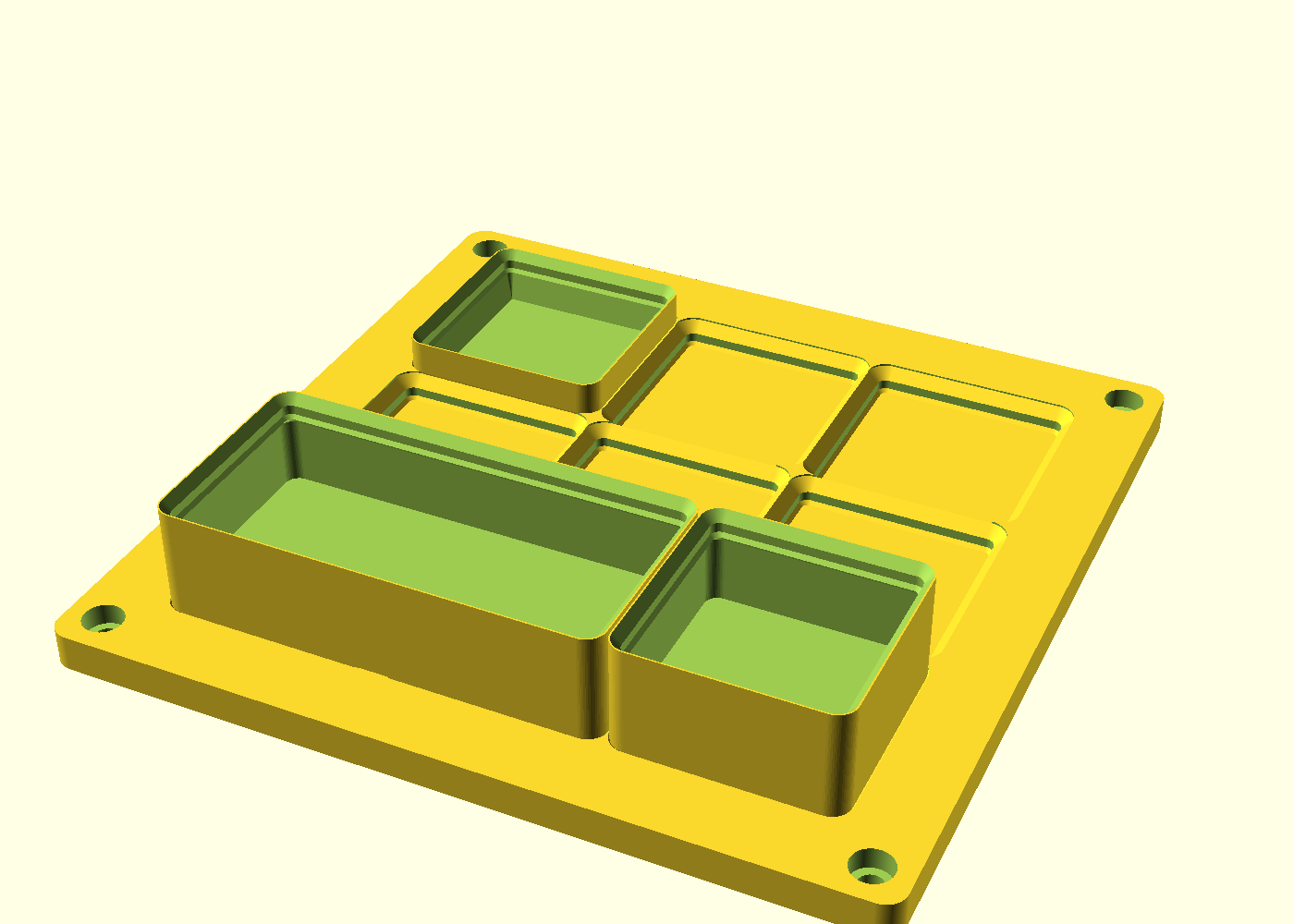
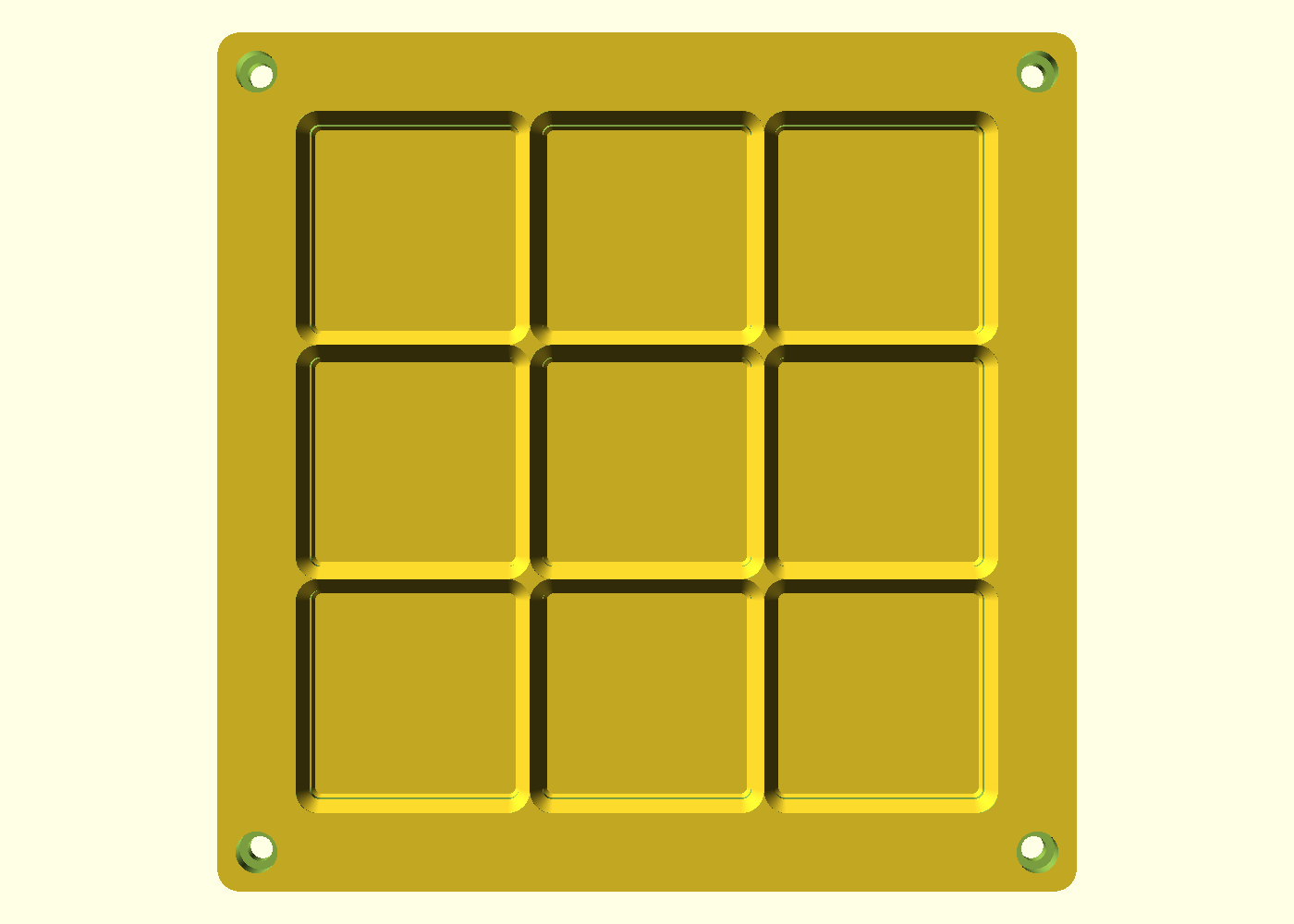
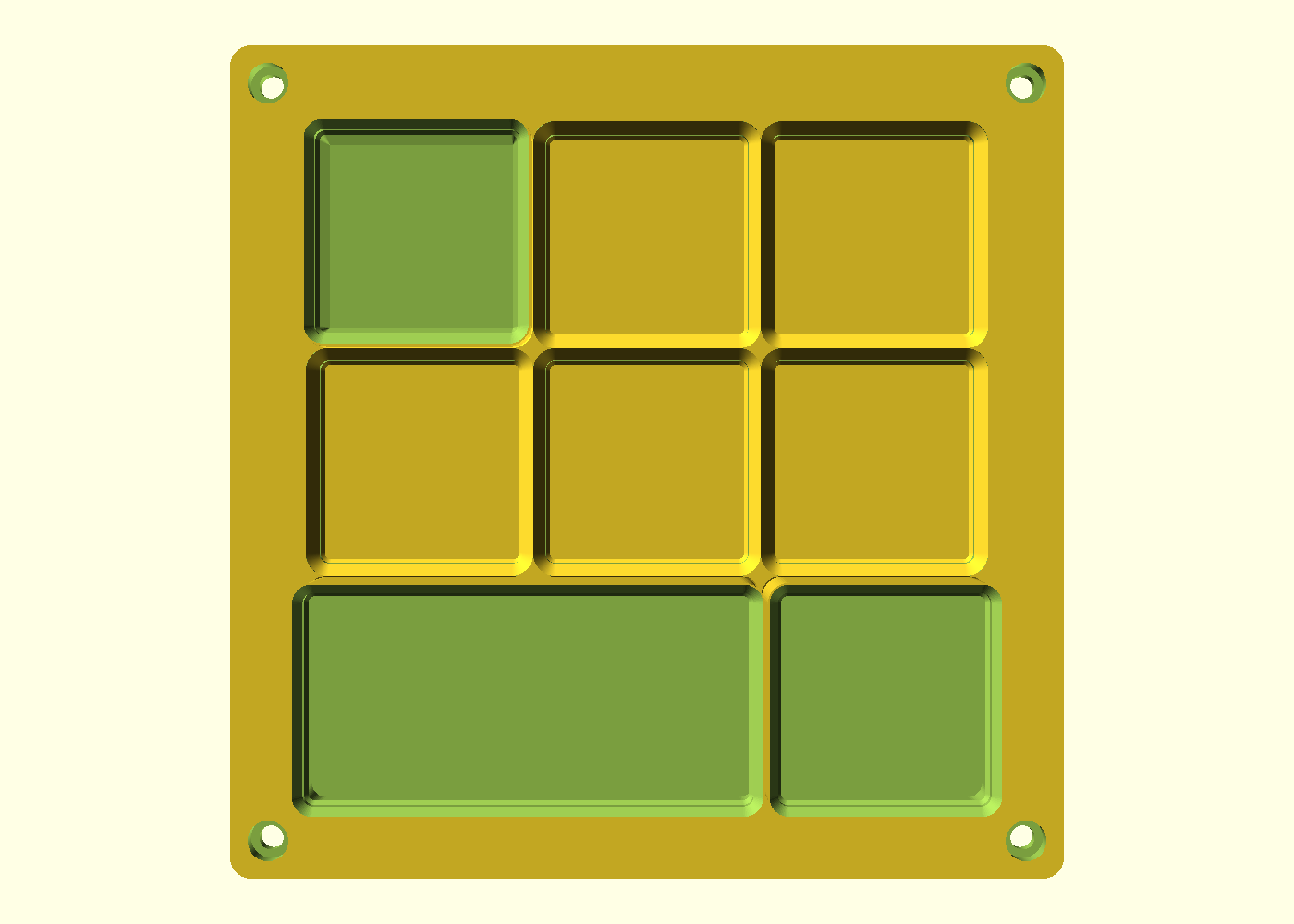
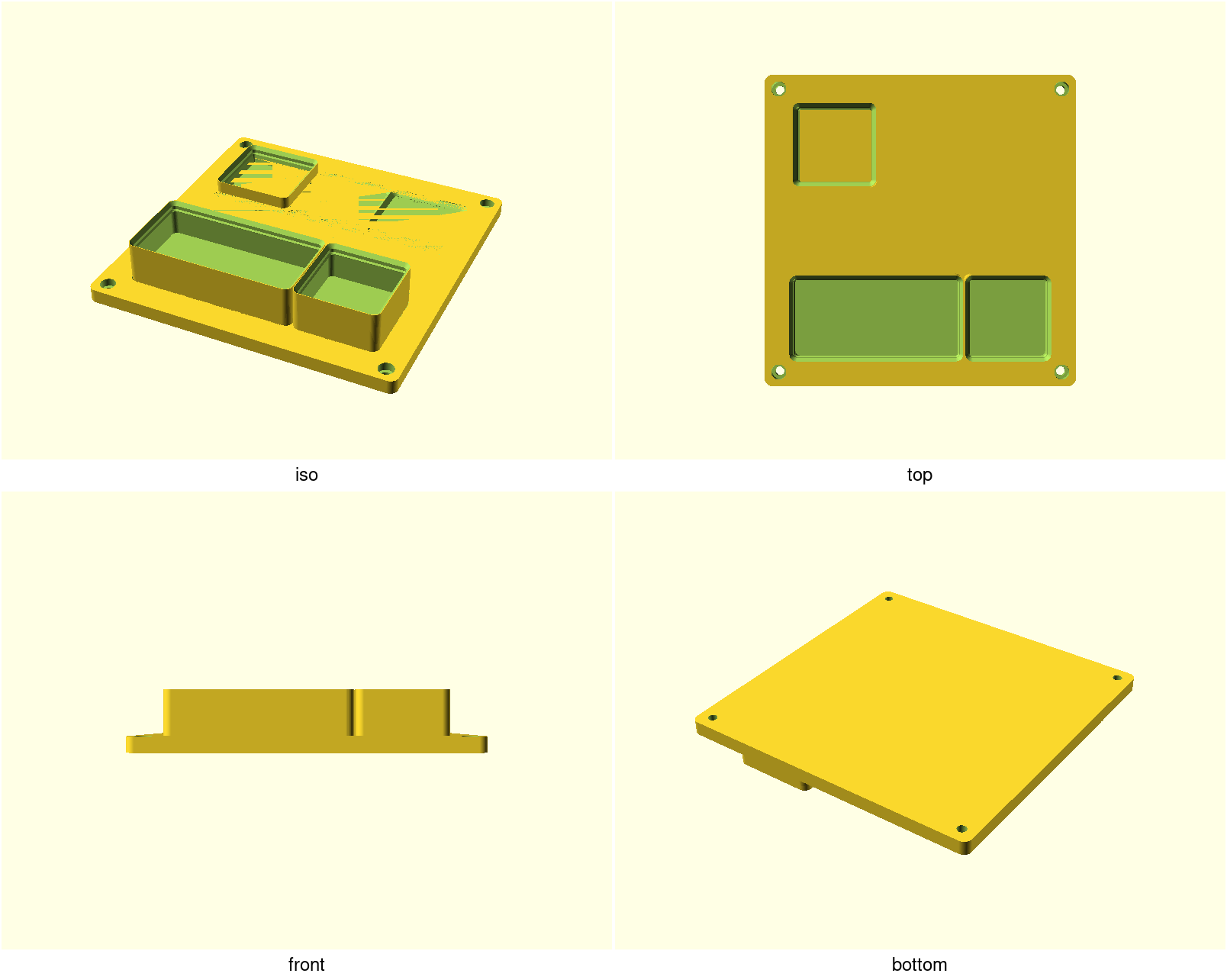
A screw-down Gridfinity baseplate (3×3 by default) and the three open bins that drop into it — printed from a clean-room, numbers-only implementation of the open Gridfinity standard, so every part here also mates with the community's bins and plates. If you want one print that turns a drawer or shelf into organized tool storage, this is it.
What you get
baseplate— 3×3 grid, 154 × 154 × 7 mm, four M4 socket-head corner mounts in the border (screws from the top; heads sit flush)bin-1x1— one cell, 3U tall (≈ 41.5 × 41.5 × 25.4 mm)bin-2x1— two cells, 3U tall (≈ 83.5 × 41.5 × 25.4 mm)tray-1x1— one cell, 1U low tray (≈ 41.5 × 41.5 × 11.4 mm)
Any bin can carry interior dividers (dividers_x/dividers_y) — the
gated proof print is bin-2x1-div, a 2×1 bin with one wall on the cell
boundary.
All four also ship as one multi-object 3MF plate (build/ gridfinity-starter-plate.3mf) — import it and your slicer sees four
separate parts, not a welded lump.
Bins stack (the lip is the socket profile), and the front lip carries a flat
label plate — set label_text before printing to emboss it, or leave it
blank for stickers.
Print settings
- Material: PLA or PETG
- Layer height: 0.2 mm (spec heights are 0.1 mm multiples)
- Infill: 15 % grid — walls and floors carry the structure
- Supports: none — every taper is the spec's own 45°; the flat socket ceilings (plate) and bin floors are ~36 mm bridges that the CI test-slice cuts clean on stock bridging
- Brim: recommended on the bins — the stacking lip ends in the spec's 0.3 mm rim, a knife-edge first layer (~50 mm² of bed contact)
- Orientation: as exported (bins opening-down, plate grid-down); do not reorient
- Print first: the coupon (
gridfinity-starter-coupon.scad) — one socket + one tray on one bed, to check thefitclearance on your printer before committing to the full set
Parameters
| Parameter | Default | What it does |
|---|---|---|
grid_x / grid_y | 3 / 3 | Plate size in cells (42 mm each) |
margin | 14 mm | Solid border around the grid; carries the M4 mounts |
mounts | true | Cut the four M4 socket-head corner mounts |
bin_units | 3 U | Bin height in Gridfinity units (1U = 7 mm, base included) |
wall | 1.2 mm | Bin wall above the base block (community: 0.95) |
label_text | "" | Text raised on the front label plate |
dividers_x / dividers_y | 0 / 0 | Interior divider walls per axis, evenly spaced (the first lands on the cell boundary of a multi-cell bin); compartments stay ≥ 8 mm |
fit | 0.1 | Socket clearance from the bin boss — 0.25 mm/side at the wall, 0.35 at the floor; tune with the coupon |
All parameters are at the top of gridfinity-starter.scad, grouped in
Customizer sections; override on the command line with
-D 'grid_x=4'. Bin grid sizes are chosen by the part values
(bin-1x1, bin-2x1, tray-1x1).
Assembly & use
Screw the plate down (or just set it in a drawer — the margin keeps it
stable), drop the bins in. A bin that's stiff to seat on a new printer:
raise fit by 0.02–0.05 in the plate and re-print just the plate — the bins
never need reprinting. Magnet pockets, weighted baseplates and plate
interconnect are deliberate follow-ups, not missing features.