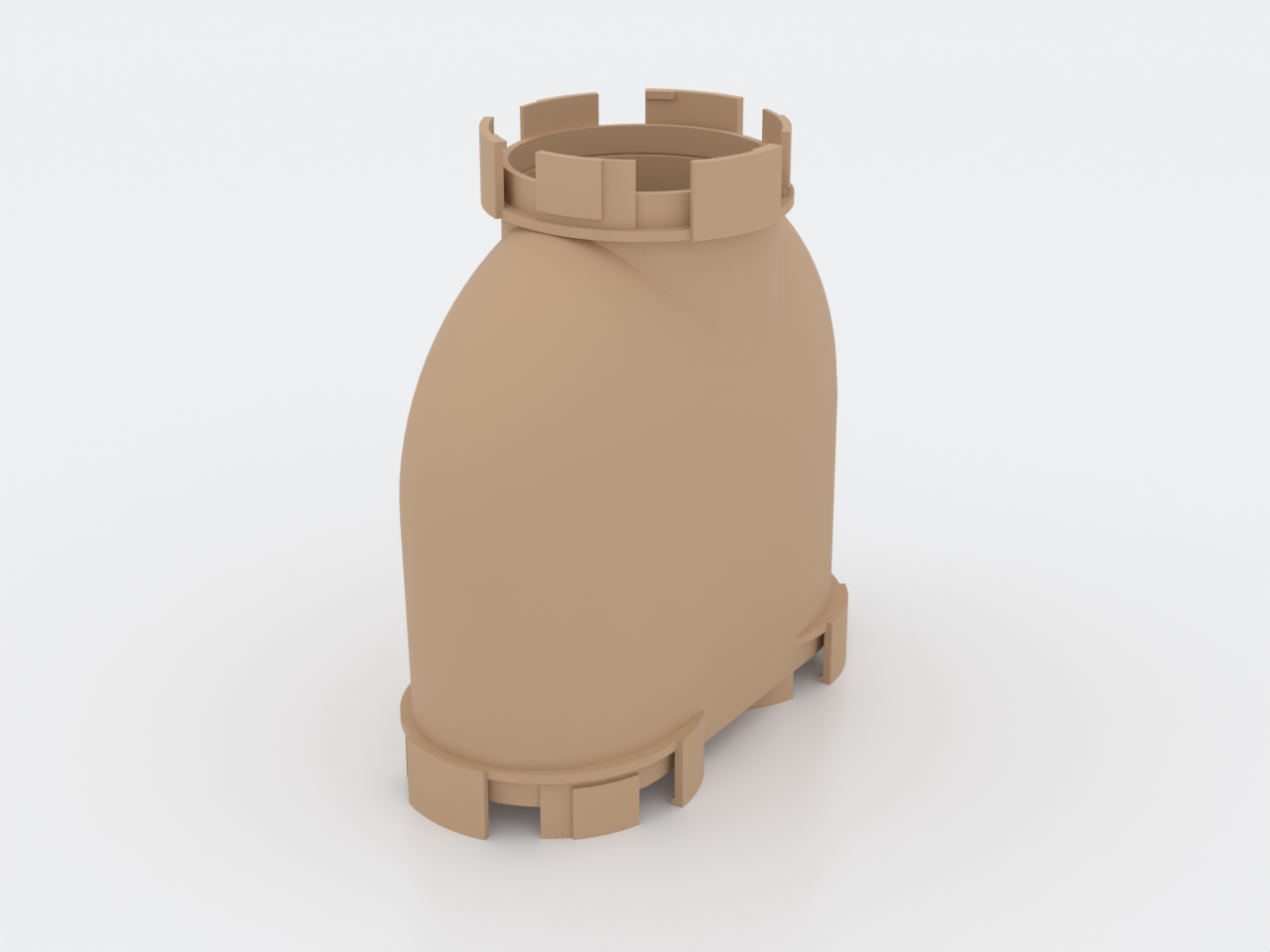
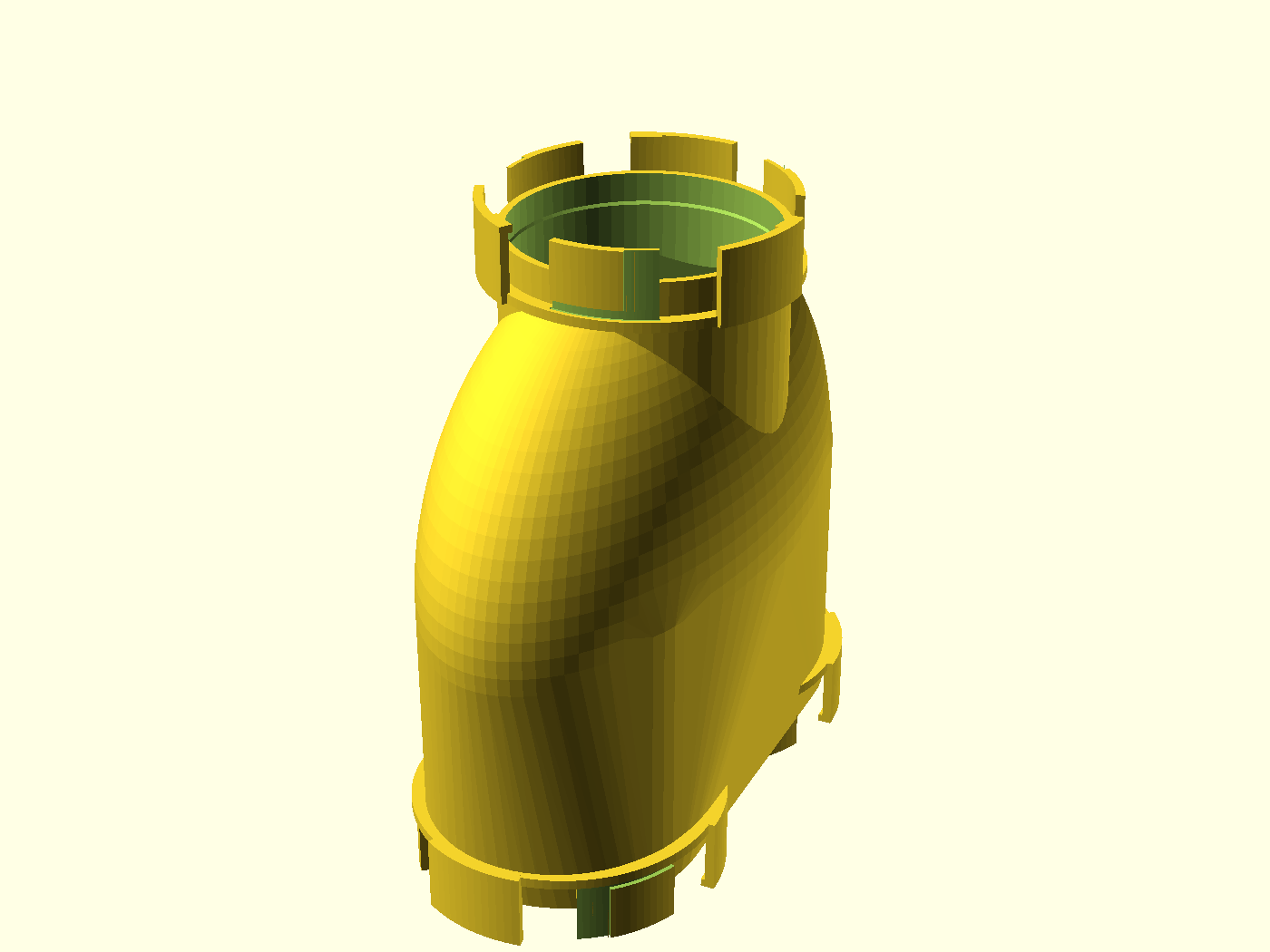
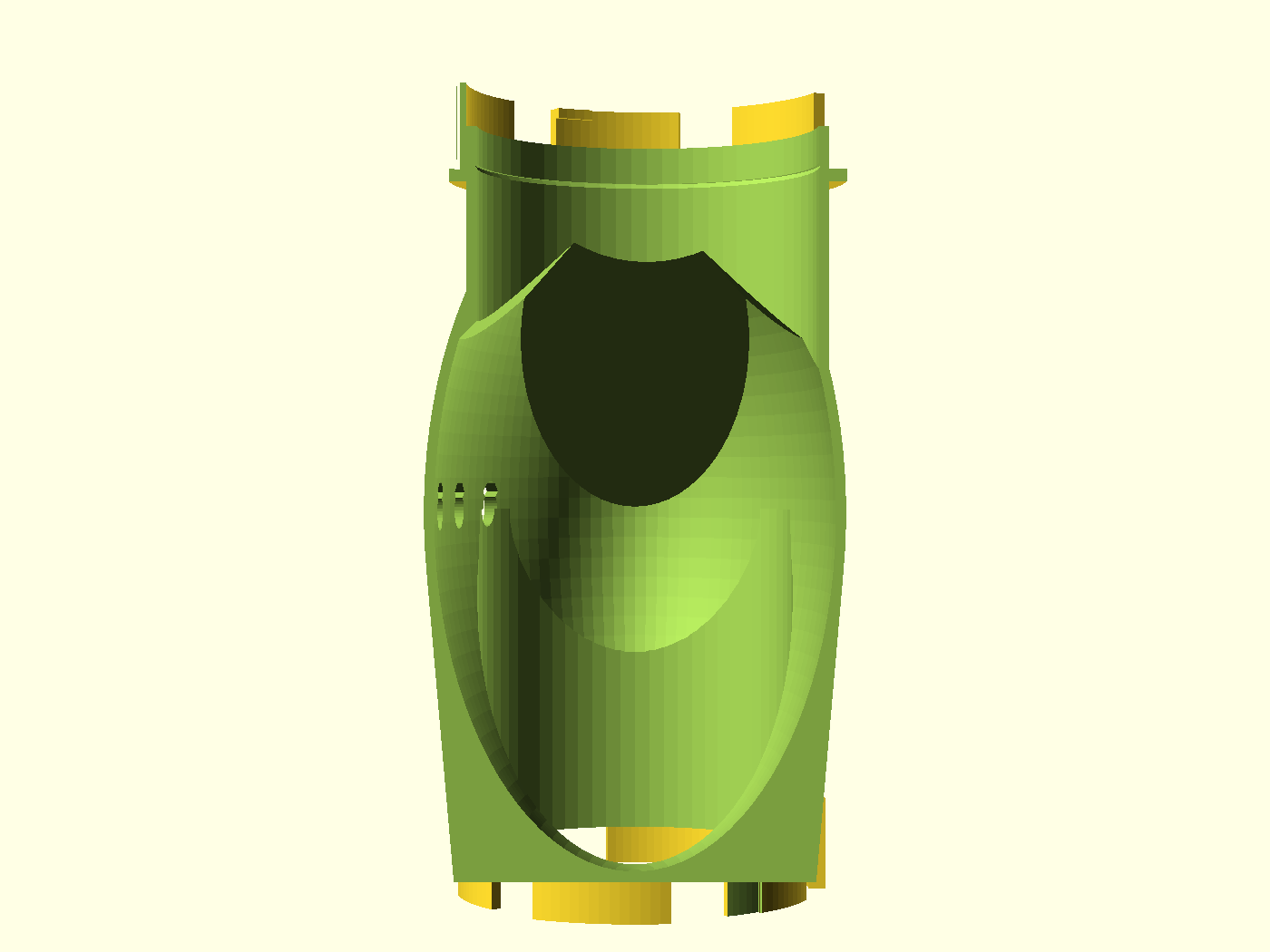
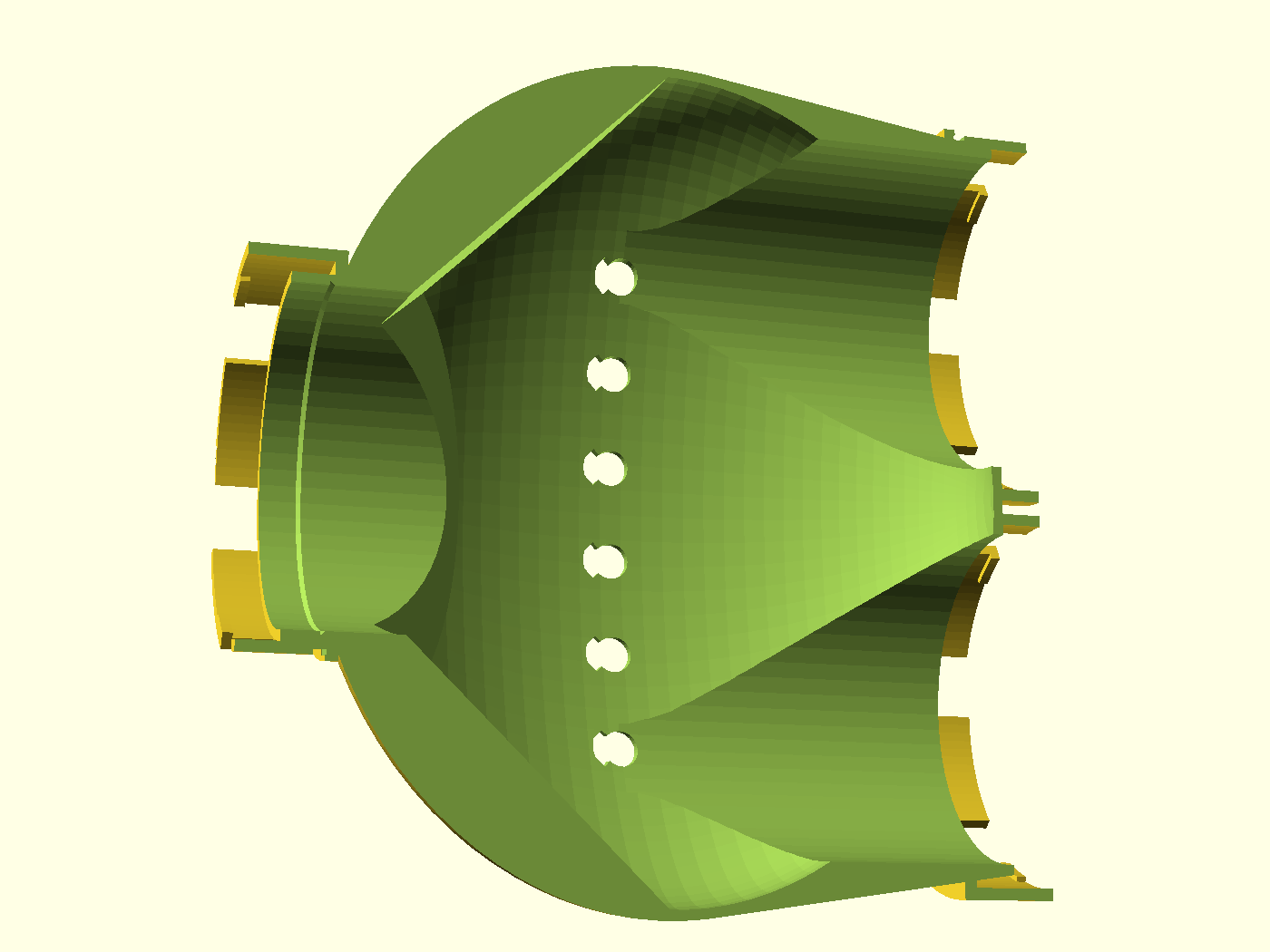
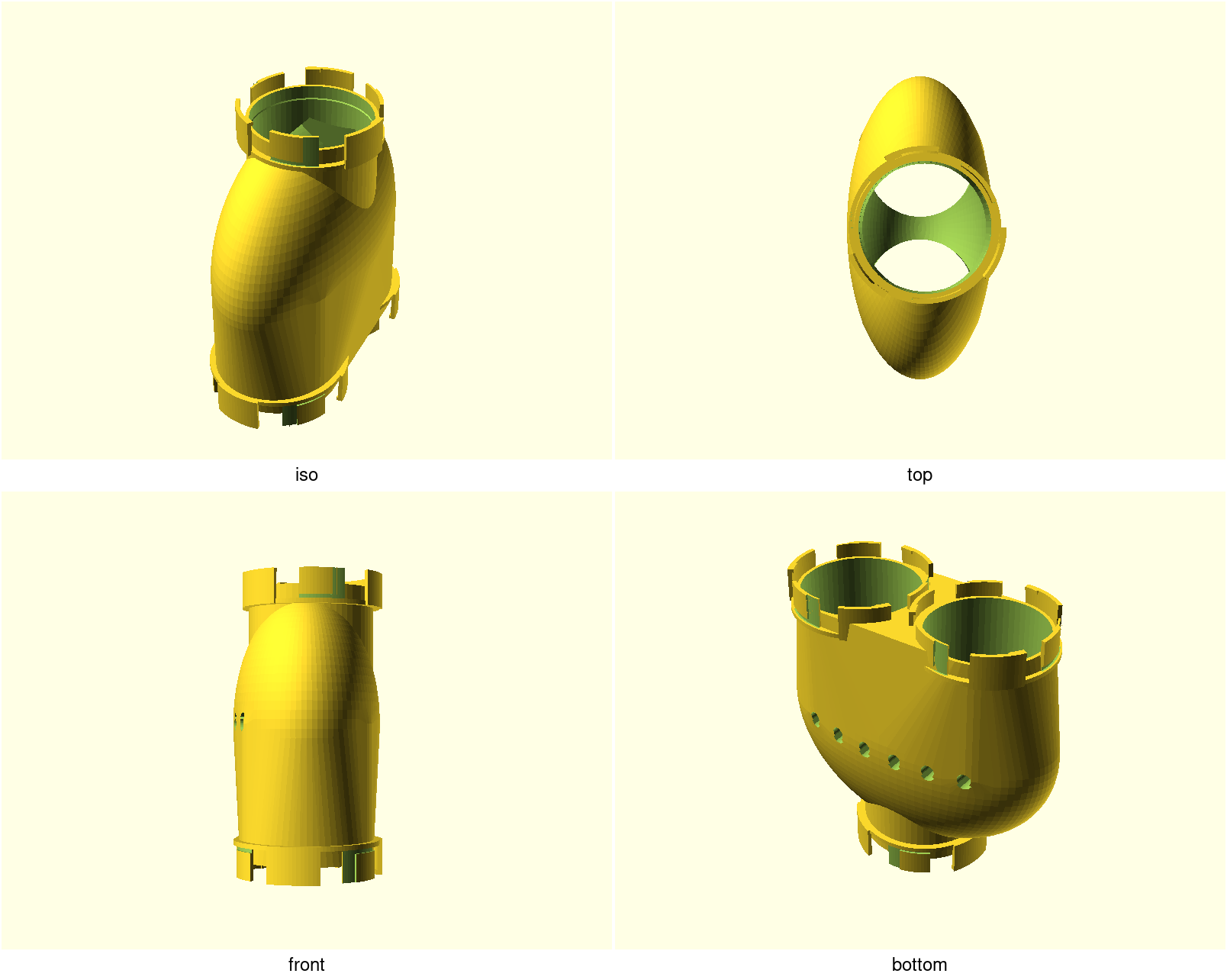
The through-and-back node for the N.U.G.G.S. hamster-tunnel system: the turnaround with a third port on the crown. Enter low, leave low and doubled back — or go straight over the top: the crown port is anti-parallel to the two bed ports, so a run can pass through this node end-to-end without turning at all, or take any pairing of the three mouths. Same Ø80 mm bore, same genderless quarter-turn coupling, same revision — it mates with every module the two-port node does, and adds the one thing a layout always runs out of: a corner that isn't a dead end and isn't a switchback either.
Work in progress — nothing in this system has been printed yet. The node passes
gate.sh --slice(printcheck + a real test-slice, support-free), butport_tol = 0.30is an untested guess inherited from the shared standard. Print the coupon first (see Assembly & use) and expect to tune it.
What this is, relative to the turnaround
This is a derivative of the two-port
nuggs-turnaround (lineage in
derives.conf); everything the parent's page documents — the
dish-not-a-floor, the vents, the coupling, the welfare rules — is inherited
unchanged and documented there, once. The delta is exactly three things:
- A third port (C) on the chamber crown, mouth up in the print pose, anti-parallel to the bed ports. Its axis sits 3 mm off the chamber centre toward the dish floor — not for looks: the through-route hands off from the dish onto port C's flat bore floor at 13.9°, inside the 15° welfare ceiling (on-centre it would grade 19°, illegal).
- The chamber is 6 mm flatter (z semi-axis 84 mm, parent 90), so the crown port's ring and sectors still fit the 256 mm build class this family gates on — the whole node is 197 mm tall as it prints. The clear internal width — the number that makes the chamber a legal run break under the welfare rules — is untouched at 200 mm.
- A repaired crown. The parent's chamber roof has a known defect (a
through-slot where its vault outruns the dome — issue
#499); the tee cannot
inherit it, because port C's collar would open
into open air. The tee closes the same crown with the vault plus a hip:
two extra roof planes descending across the chamber, so every ceiling
surface is steep enough to print support-free and the shell keeps ≥ 2.7 mm
over the cavity everywhere. Asserted by sampling in the
.scad, not eyeballed.
What you get
turnaround— the node (≈ 101 × 206 × 197 mm at defaults): an oblate chamber over a solid web, two Ø80 mm ports on the underside, the third on the crown, six ceiling vents.coupon— the standard NUGGS port stub (~21 mm, ~2 h to print) for tuning the joint fit before you commit ~20 h of printing. Port C is the same port rigidly rotated, so one coupon covers all three mouths.
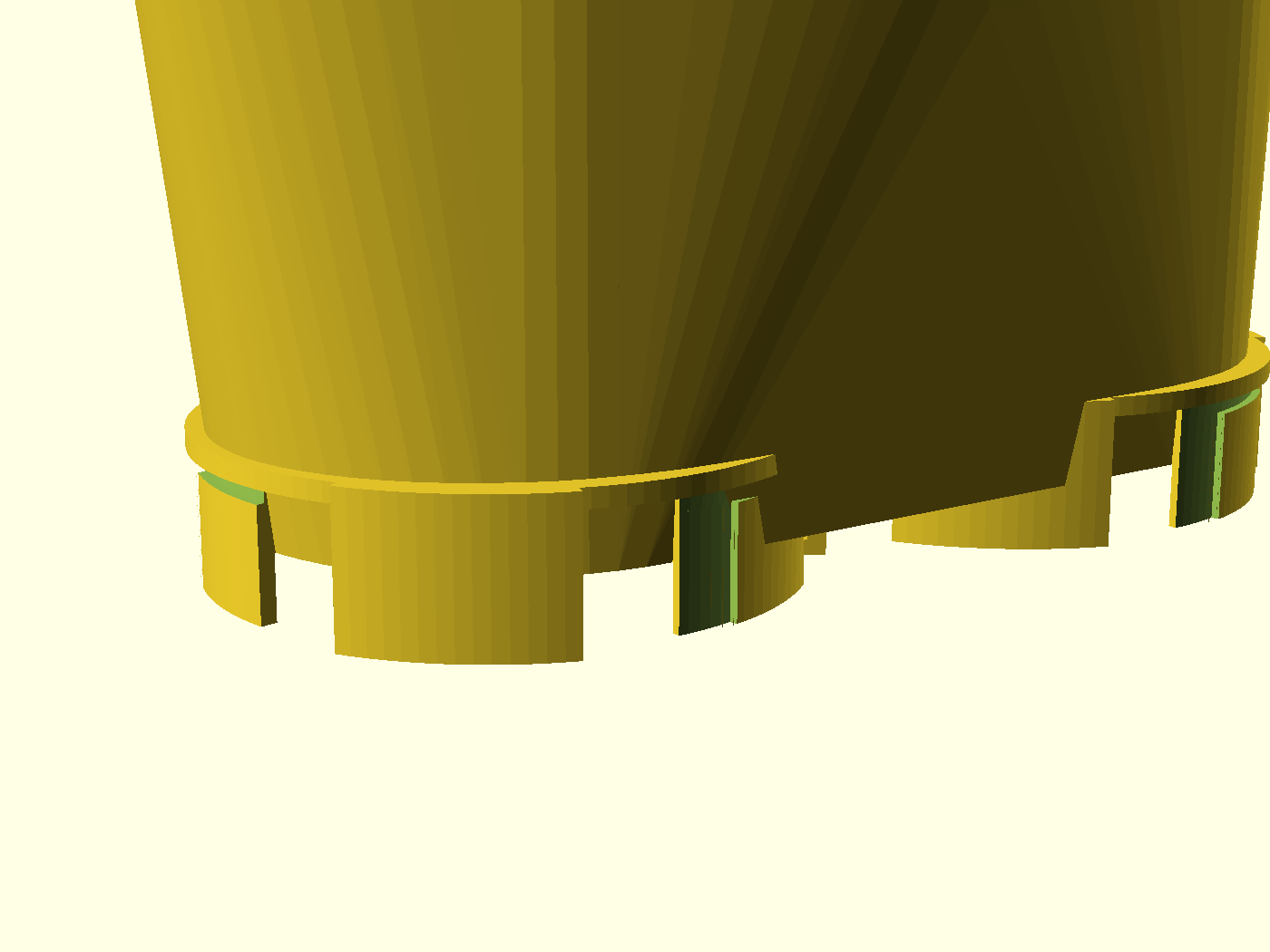
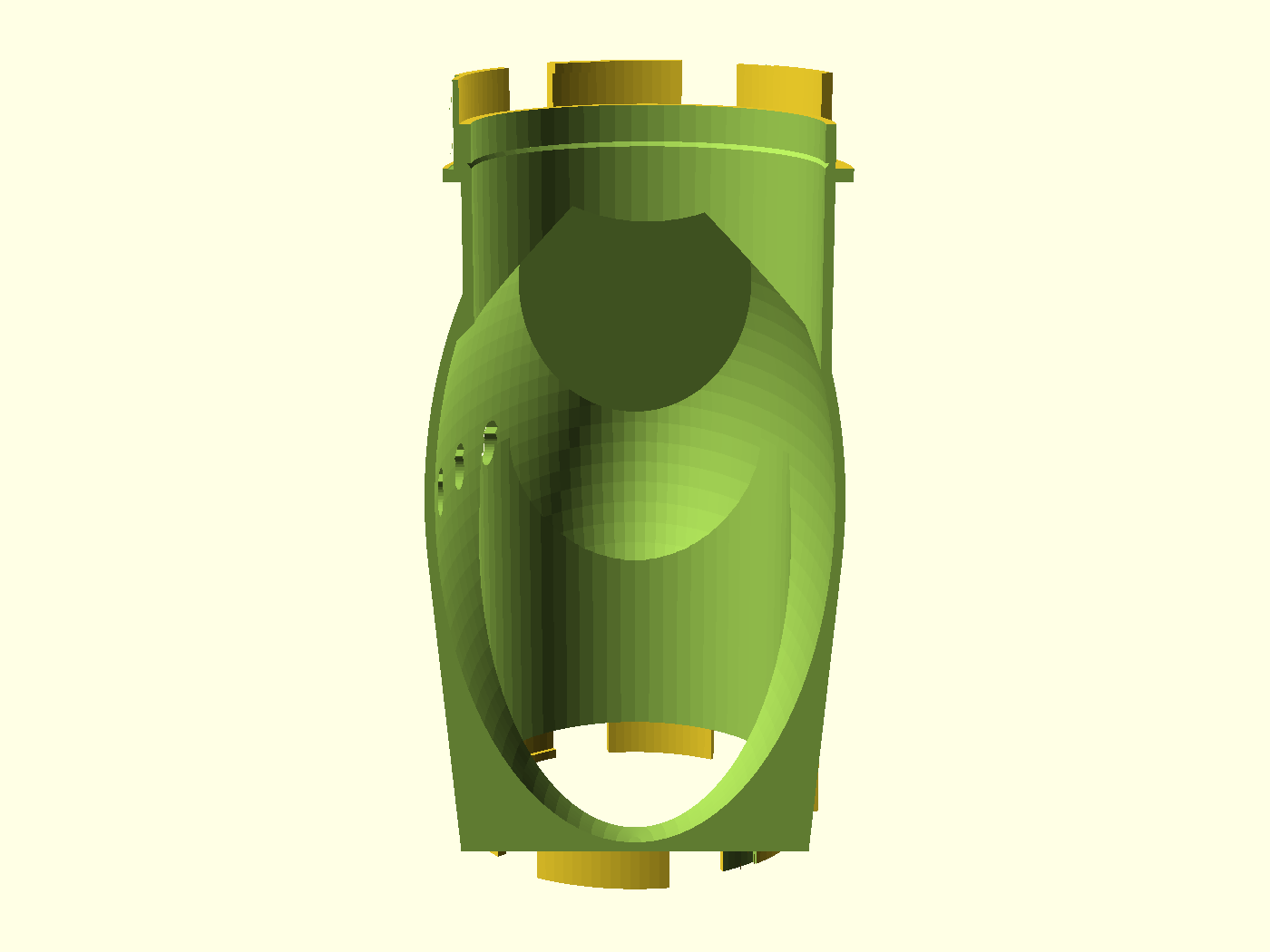
The bed-port faces are in the contact sheet's bottom-iso quadrant; the crown port and the through-route are in the sections below.
The two routes the shape is doing
- The switchback (inherited). Enter port A, step ~1 mm down onto the dish, cross, pivot in the 200 mm bowl, leave port B. Grade peaks at 14.6°, and eases to flat at the bottom of the bowl.
- The through-route (new). Enter port A, cross to the bowl, climb the far side of the dish — the grade falls as you climb, from 14.6° to 13.9° at the handoff — and step onto port C's flat bore floor, which runs straight up and out the crown. No lip in either direction: the dish floor only ever widens onto the bore floor.
Both routes are proven the same way the parent proves its one: a Ø60 animal
envelope swept along every route must stay inside the part's own material
(path-clear renders zero facets; a deliberately shifted control must
interfere — the check is demonstrated able to fail).



Print settings
- Material: PLA if it lives at room temperature; PETG for a node that will be scrubbed or run warm.
- Layer height: 0.2 mm.
- Infill: 15–20 % is plenty; the shell does the work.
- Seam: Back (or scarf) — same setting for the coupon and the node; stock
Aligned stacks a ridge on the port collar that reads as
port_toltoo tight. - Supports: none needed. The two bed ports print down on their sector tips exactly as the parent's do, the crown port prints mouth-up with its collar on the dome, and the repaired roof keeps every enclosed ceiling at or steeper than the coupling's proven 45° class. Keep auto-supports off even if your slicer offers them: anything it builds inside the chamber is unreachable through six Ø9 mm vents.
- Orientation: as modelled — bed ports down, crown port up. Do not rotate it.
- Brim: off. Only the bed ports' sector tips touch the bed; the first ~50 layers print as twelve small islands that merge at the port plane — expected, not a fault, and a brim would weld across the mating feet.
- Heads up: 197 mm tall — check your Z before you start. It fits the 256×256×256 class this family gates on, but it is a big print: CI's test-slice reports ~20 h and ~300 g at 0.2 mm (the coupon is ~2 h).
Parameters
The handful most worth tuning; the rest are grouped in the Customizer sections
at the top of nuggs-turnaround-tee.scad.
| Parameter | Default | What it does |
|---|---|---|
port_tol | 0.30 mm | The one fit knob for the quarter-turn joint. Tune on the coupon in ±0.05 steps. |
port_c_x | 3.0 mm | Crown-port axis offset toward the dish floor. Sets the through-route's handoff grade (13.9° at +3; 19.0° and illegal at 0). |
port_c_face | 177 mm | Crown-port face height — sets the node's total print height (197 mm at defaults; 199 is the gate's test-slice ceiling). |
tee_az | 84 mm | Chamber half-height. Pairs with tee_zc (= tee_az + wall, the pole-flush belly rule). |
hip_deg | 46° | Slope of the repaired roof's cross-planes. Just past the 45° supportless ceiling. |
bore_d | 80 mm | Internal bore — the shared NUGGS headline number. |
chamber_ay | 100 mm | Chamber half-width along the turn axis — the clear internal width is 2× this (200 mm at defaults). |
max_incline_deg | 15° | The welfare ceiling on route grade. Both routes' grade asserts key on it. |
n_vent / vent_d | 6 / 9 mm | Ceiling vent count and diameter. |
wall | 2.4 mm | Shell thickness — about six perimeters at a stock 0.42 line width. |
Override on the command line with, e.g., -D 'port_c_x=5'. Every dimension
above is enforced by an assert in the .scad — including the two the
parent lacked: a sampled minimum roof-shell check and a sampled every-governing-
surface-≥45° check, both held over a grid rather than at the section plane
alone.
Assembly & use
- Print the coupon first (
nuggs-turnaround-tee-coupon.scad, ~21 mm stub) — in the same material as the node. Mate two of them (or one to any NUGGS module): it must insert to the collar face and lock with a light quarter turn — firm, no rattle, no forcing. Forcing loose → raiseport_tol+0.05; will not lock → lower 0.05. If it inserts but the quarter-turn grinds near the lock, deburr the sector tips' first layer with a blade before touchingport_tol— or set Elephant foot compensation to 0.2 mm for the coupon and the node. - Print the node bed-ports-down, no supports, no brim.
- Fit it one port at a time — push together, twist a quarter turn whichever way. With three mouths there are three pairings; the crown port couples exactly like the others (it is the same port rigidly reoriented — quarter-turn either way, no handedness to match).
- Place it where the run needs both a corner and a way through: the crown port takes a riser, a shelf hop-up, or a second storey; the bed ports take the switchback. In use the node stands 197 mm along the riser and 206 mm across the run. Bedding will collect in the dish — strip it at the weekly clean (the vents' no-purchase argument assumes the ceiling stays a full standing reach away), and hand-wash only, lukewarm (≤ 50 °C), never the dishwasher: heat deforms the shell, and a deformed tube is a narrowed tube — the material failure mode is the injury failure mode (family charter N7).