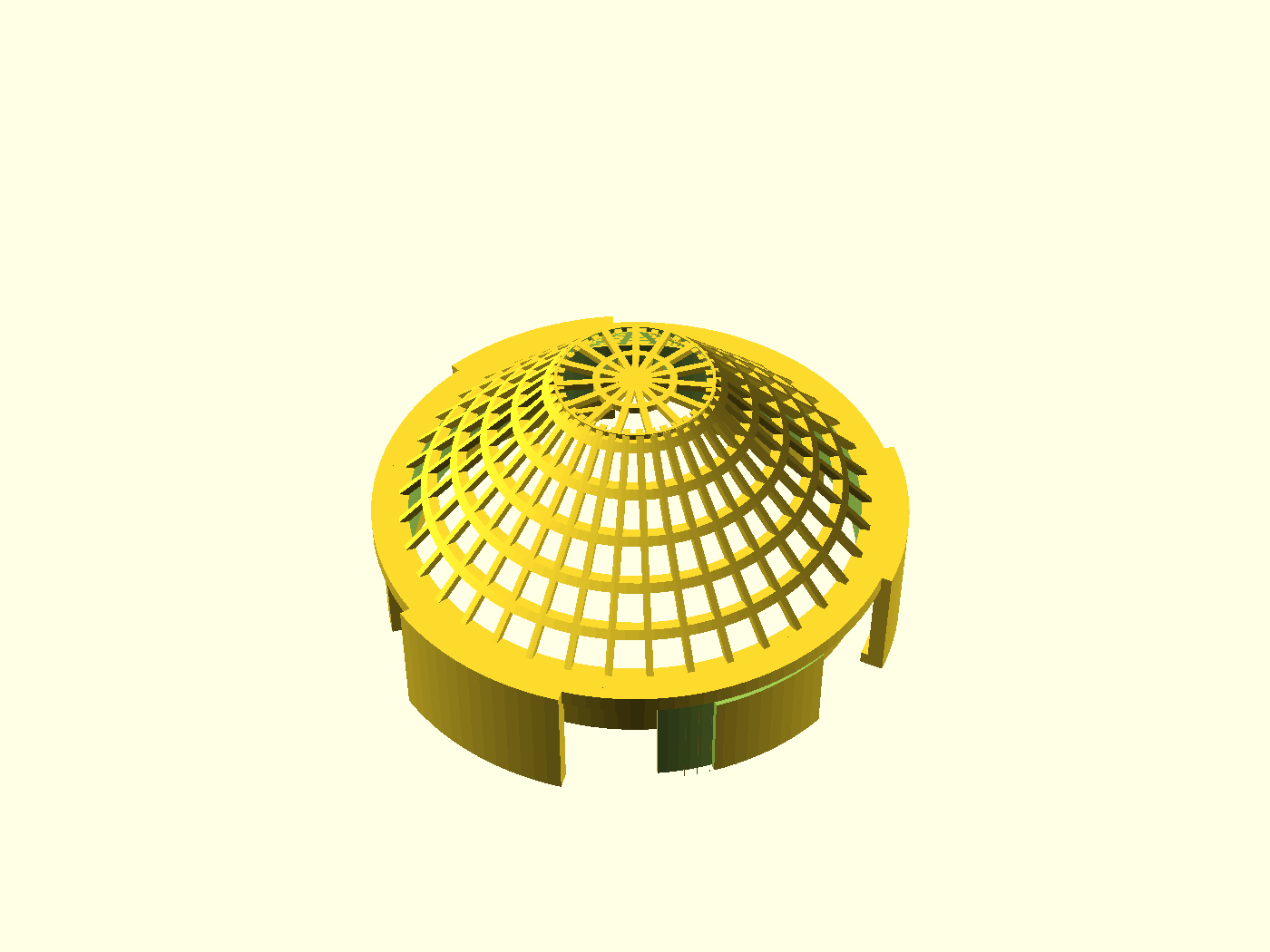
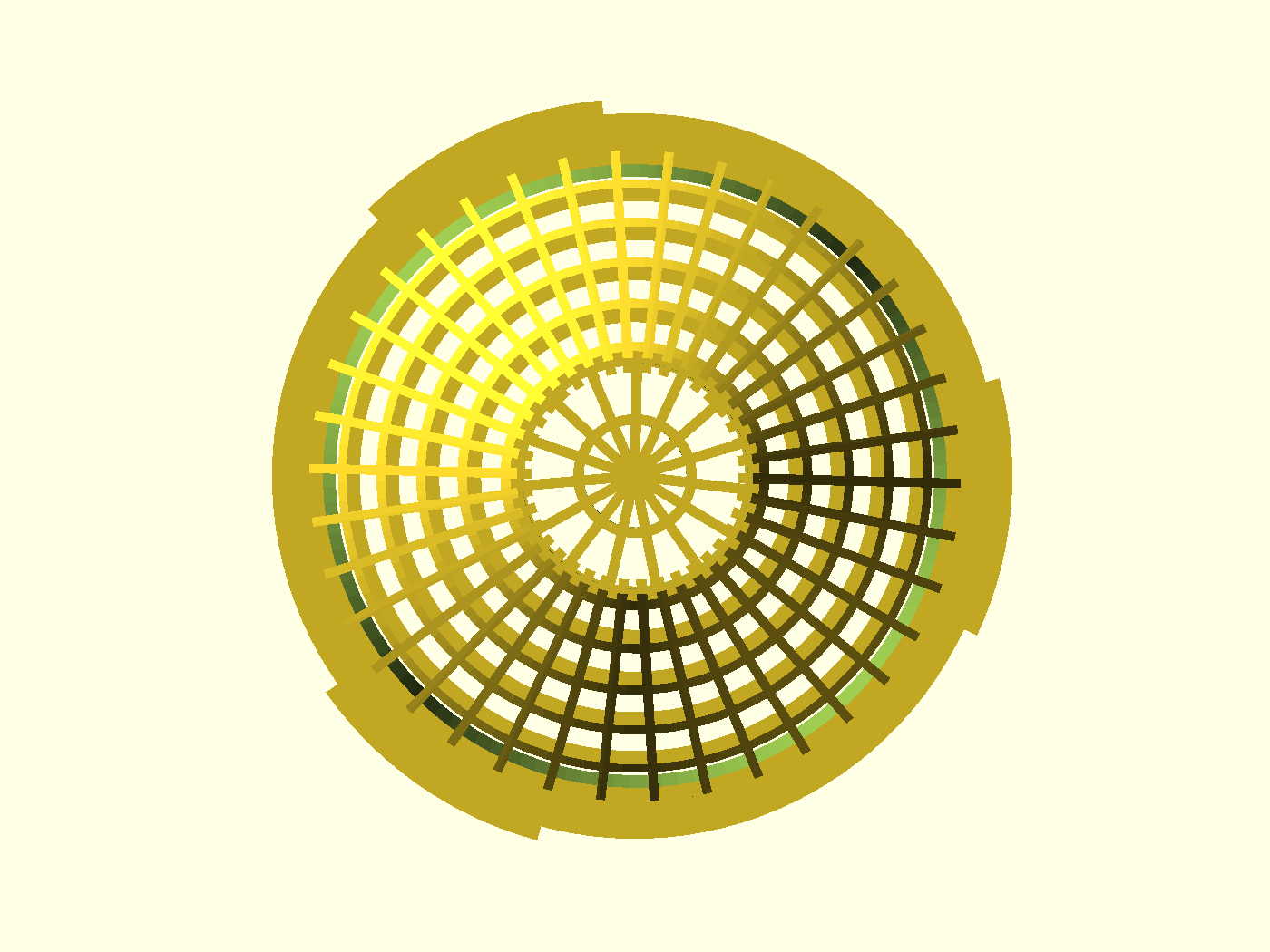
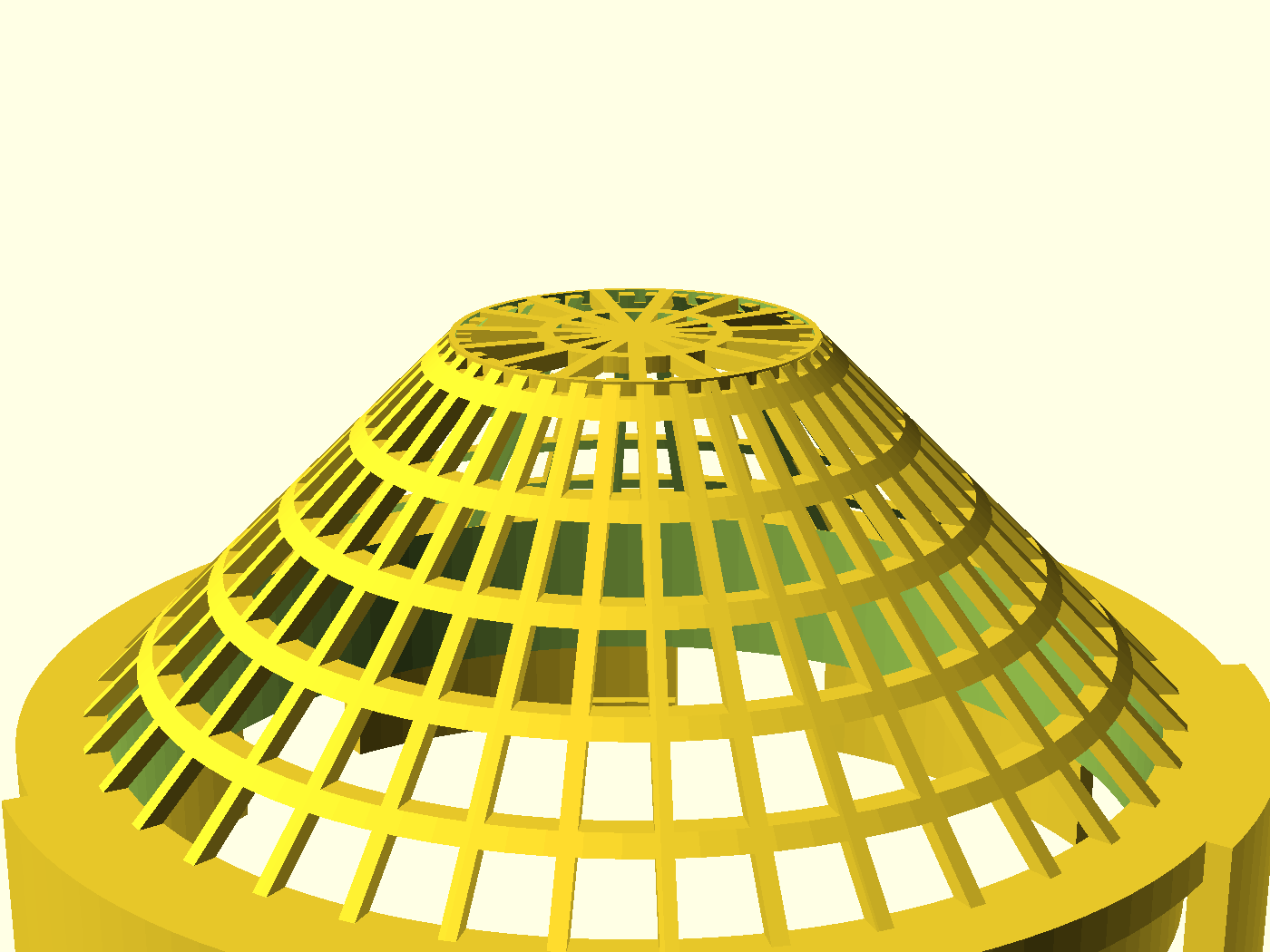
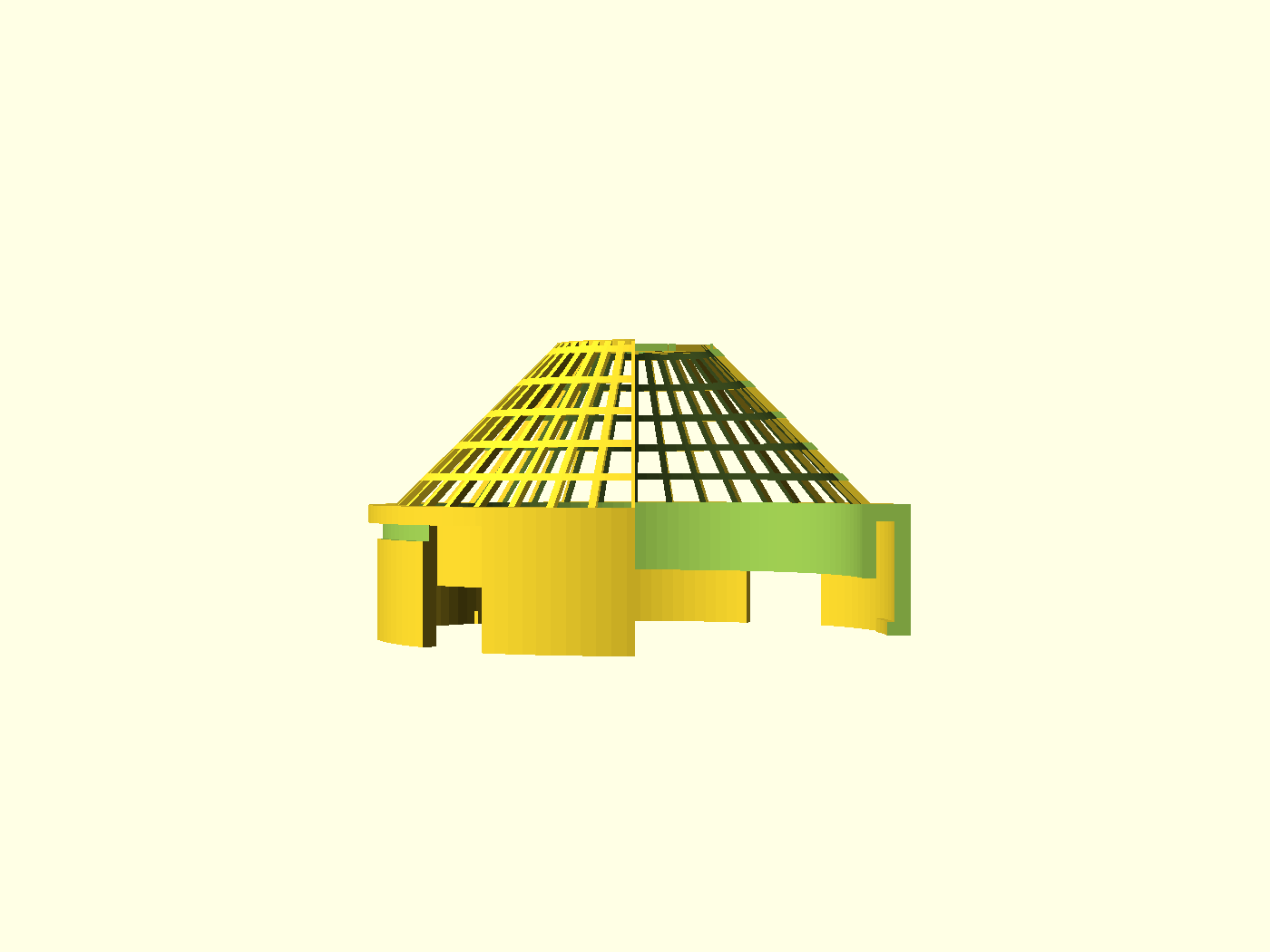
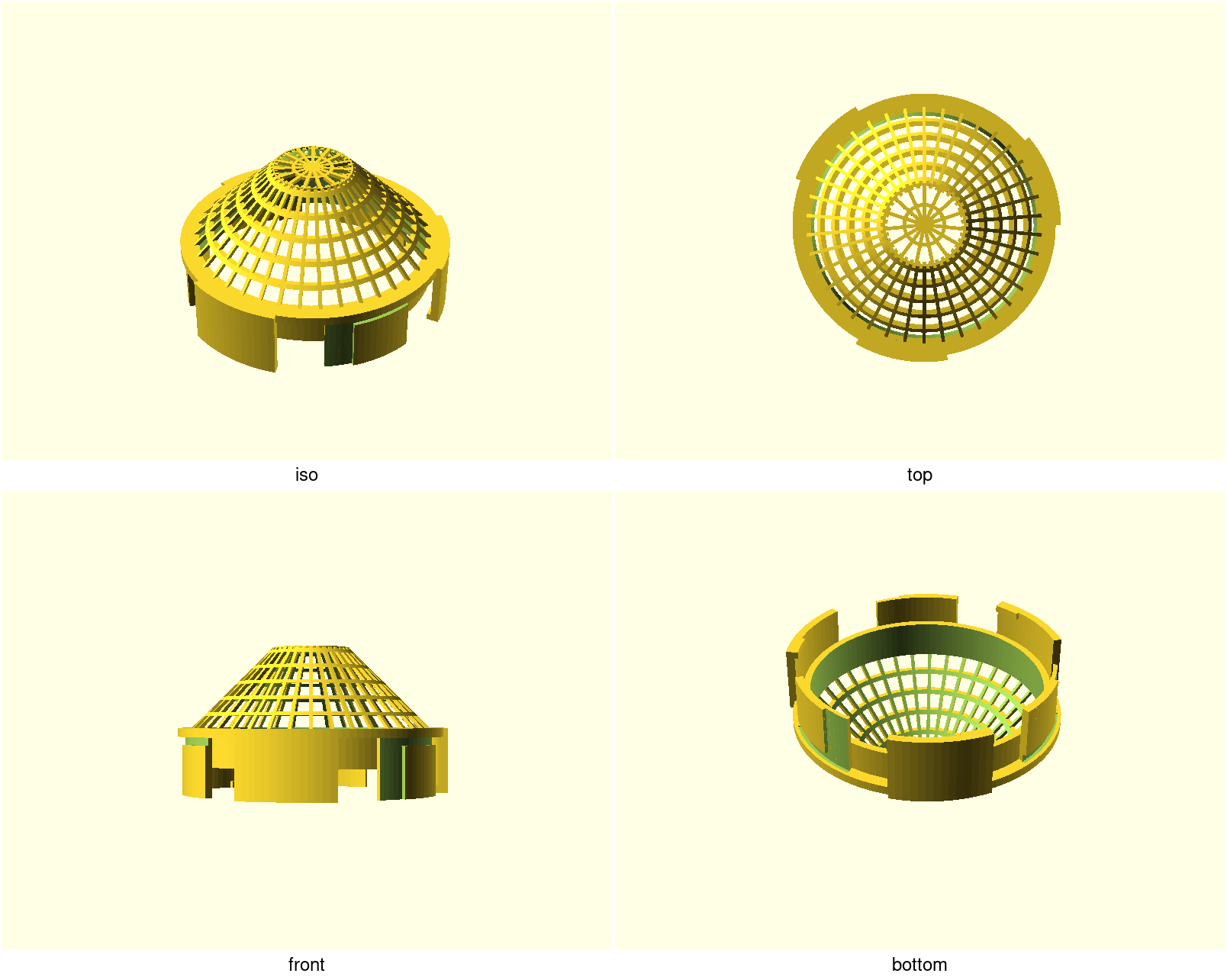
The breathing end-cap: the standard NUGGS quarter-turn port closed by a support-free lattice dome. Air and light pass, bedding stays in, and openings stay at or under the assumed 6 mm welfare ceiling (the 1/4″ hardware-cloth convention — owner confirmation on a live animal is still pending) — an enclosed run end that doesn't seal the system dead. Prints upright with no supports, clicks into any existing NUGGS module, and tunes its whole welfare envelope with two numbers.
What you get
vent-cap— the lattice cap. Ø94.9 mm across the coupling ring, 51 mm tip-to-crown (41 mm of that above the port face), 80 mm bore. ~30 g in PETG at 15 % infill (slice-measured).vent-cap-solid— the closed variant: a hollow 45° cone closed near the tip (open underside, no flat ceiling across the bore), 65 mm tall (gated export 64.7 mm). See Solid variant below.coupon— if you've already dialedport_tolon another NUGGS module on this printer, reuse that value and print just the cell:openscad -D 'part="coupon-cell"' -o cell.stl designs/nuggs-vent-cap/nuggs-vent-cap.scad(or Customizer →coupon-cell). New to the standard here: the print-this-first plate is a port stub beside one lattice cell at production pitch — about 2 h 18 m / ~30 g (slice-measured), about the same as the lattice cap. Caliperstrand_wand the opening at the top face, not the base (first-layer squish narrows the opening at its base; the dome's openings print well above L1). If the stub scratches on first insertion then firms up past the tip, scrape the elephant foot off the sector tips with a blade before touchingport_tol. SeeNOTES.mdfor the tuning steps.
The cap is one printed part. Its port face is every nuggs_cfg() default, so
it mates with the straight, the elbow, the den, the turnaround — any module on
the standard.
Solid variant
The photos are the breathing lattice. The same file also ships a closed
cap — pick it when you want to terminate a run dead rather than breathing
(dark nesting, light blocked, almost no airflow). Same 45° cone as a hollow
shell closed near the tip (open underside so it prints support-free like the
lattice — no flat disk across the bore), no crown bridge; physics makes it
taller, 65 mm tip-to-crown versus the lattice's 51 mm — about 2 h 42 m / ~35 g
versus the lattice's 2 h 47 m / ~30 g (slice-measured). Hollowing the cone
(open underside) cuts the filled-cone plastic from about 57 g to about
35 g — roughly 40 % less — while keeping the support-free claim. The
shell is 1.2 mm (strand_w); if darkness is the point, print it in an
opaque, dark filament.
CI gates and slices it as vent-cap-solid
(build/nuggs-vent-cap-vent-cap-solid.stl). In the Customizer, set lattice
to false; on the command line, -D lattice=false or
-D 'part="vent-cap-solid"'. Use & care below applies to this cone too,
including family N7 (hand-wash ≤ 50 °C, never a dishwasher) — a closed
tip traps more humid air than the lattice.
Print settings
- Material: PETG (gnaw-durable); PLA fine for a calm cage. Print the
coupon in the same filament as the cap — PETG fits run ~0.1 mm tighter
than PLA, so a PLA coupon does not prove a PETG cap. PLA prints the
cleanest lattice; PETG sags and strings on the small bridges — a heat gun
or side-cutters tidy whiskers before fitting (animal elsewhere). For a
chew-facing preset, raise
strand_wto 1.6 and stay on PETG. Either way, family N7 still applies — see Use & care - Layer height: 0.2 mm
- Infill: 10–15 % grid, guides only — the lattice is the structure
- Seam: Back (or scarf) — stock Aligned stacks a ridge on the Ø94.9
coupling ring and can eat into the 0.30 mm of
port_tol - Supports: none — the dome is a 45° lattice cone by design; every strand underside is a sub-5 mm bridge, and the crown disc bridges its own ~10 mm spokes
- Orientation: as modeled — port axis vertical, standing on the coupling's sector tips
- Brim: none; the sector tips are the family's standard bed contact
Parameters
| Parameter | Default | What it does |
|---|---|---|
aperture_max | 6.0 mm | Largest passage through the lattice — the welfare number. The ¼″ hardware-cloth convention for a Syrian (convention; confirm for your animal); dwarf keepers: 5.0. An assert refuses anything over 6.0. |
strand_w | 1.2 mm | Lattice strand width — three perimeters at a 0.4 mm nozzle. Raise to 1.6 (with PETG) for chew durability, or if your printer under-extrudes thin strands. |
dome_rise | 28.0 mm | Dome height above the port zone. The length-vs-bridge trade: lower = shorter cap, bigger crown bridge. A droopy PETG crown means raise dome_rise 2–3 mm (taller cap, shorter crown bridges); lowering only buys ~1 mm before the assert fires (dome_rise ≥ ri−13 = 27 at defaults). |
port_tol | 0.30 mm | The fit knob. Unmeasured — tune on the coupon in ±0.05 steps before printing the cap. |
lattice | true | false = the solid variant (vent-cap-solid): blocked, taller. |
bore_d, wall, … | 80 / 2.4 | The NUGGS standard, at nuggs_cfg() defaults. Changing these un-mates the cap from every module you already printed. |
All parameters are at the top of nuggs-vent-cap.scad,
grouped in Customizer sections; override on the command line with
-D 'aperture_max=5'.
Use & care
- Fit: push onto any NUGGS port face and twist a quarter turn. It should
click firm with no rock — if not, tune
port_tolon the coupon first (0.30 is the standard's default and has never been measured on a printer). - Clocking: any quarter-turn position seats; the port is genderless like the rest of the system.
- Condensation and wash (family N7): both the lattice and the solid variant trap humid air at the tip — the closed cone more so. In humid rooms, pull and dry the cap weekly, and keep bedding off the dome's underside. Bedding also packs the port's lug pockets — blow them out when you pull the cap. When you wash it, hand-wash either cap (NUGGS family N7): ≤ 50 °C only, mild unscented dish soap is fine, rinse and dry fully — never a dishwasher (the heated dry cycle exceeds even PETG, and a warped port is a narrowed bore).
- Chew / welfare: the 6 mm aperture is a mesh convention, not a chew proof — inspect the widest (lowest) cells weekly and treat the lattice as replaceable if the resident gnaws. A chewed-through cap is a reprint (about 2 h 47 m / about 28.5 g per episode), not a repair; there is no dome-only spare.
- Airflow: the lattice holds ≥ 30 % open area by construction. If a keeper
reports stuffiness, the lever is
aperture_max(within the welfare ceiling) — never thinner strands. - Filtration: this is a vent, not a dust filter. Fine particulate filtration is out of scope by design.
- No hardware: nothing to buy — no mesh, no screws, no glue.
Design notes
The dome's shape is forced by an integral, not a taste call: support-free
surfaces climb at most 45°, so a continuous closure of an 80 mm bore needs
≥ 40 mm of rise — more than the cap-length budget holds. The lattice cone
spends its 28 mm of rise closing 28 mm of radius and hands the last 12 mm to a
bridged crown disc. The full derivation, the welfare numbers and the
decisions log live in NOTES.md.