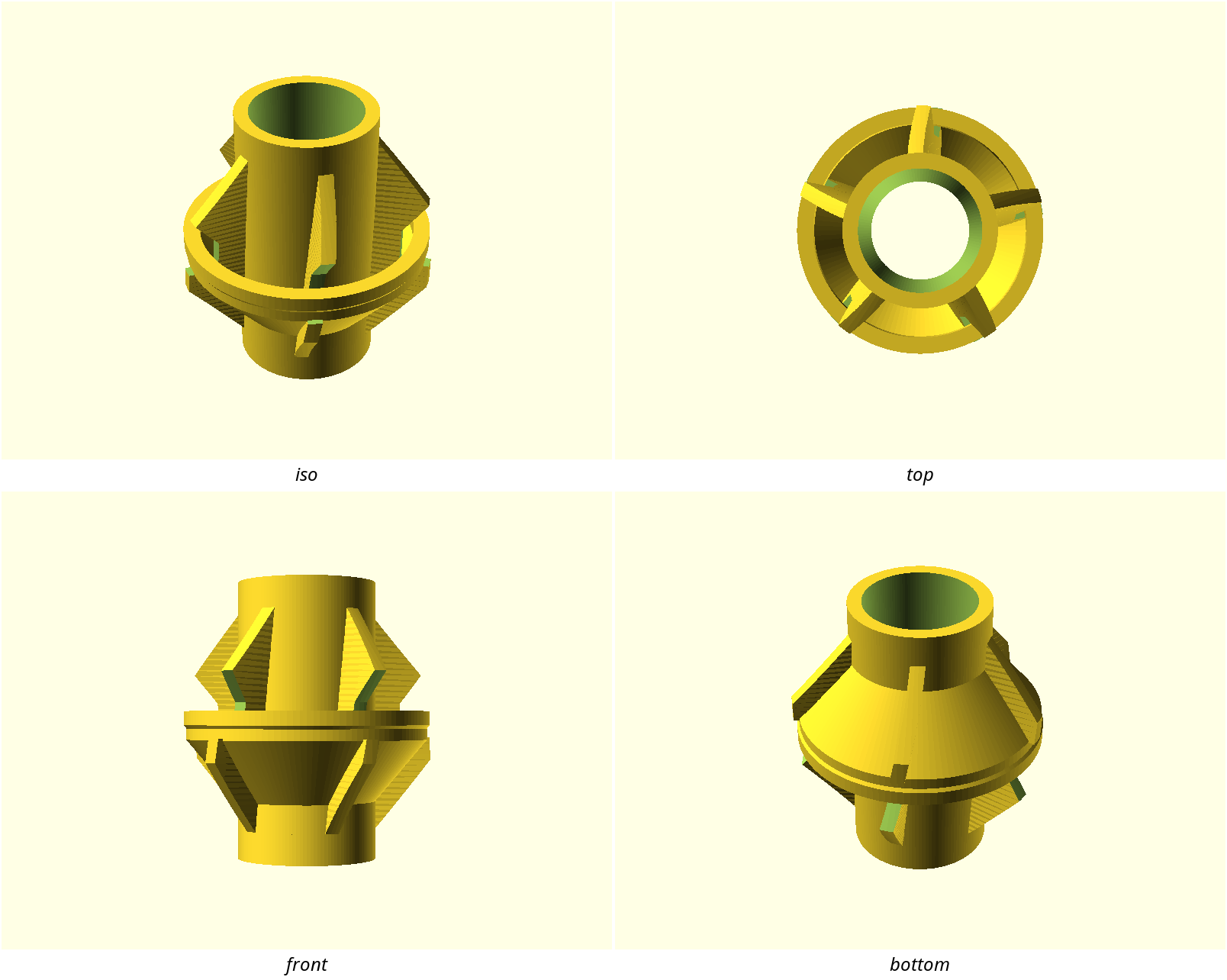
Orrery
A kinetic machine-jewellery language: helically twisted blade cages around a core, carrying captive, free-moving rings in a contrasting second material, every seat and lead-in cut at the same 50° self-supporting cone. A part in this style looks like it is mid-motion even when still — and its signature move is that the moving piece cannot be removed and was never installed: it was printed where it lives.
The family in one sentence: vertical drama (twisted sharp blades), one chamfer (the 50° ramp, everywhere), and at least one trapped thing that moves.
Do / Don't
- Do cut every lead-in, roof, seat and flare at
style_ramp_deg— one angle for the whole part. The ramp is simultaneously the look and the reason the style needs no supports; a second chamfer angle reads as another family. - Do keep blades
style_blade_ththick, knife-edged (no rounding on blade edges), twisted at aboutstyle_blade_twist_rate°/mm of height. Guard the lean:atan(r_max · rate·π/180) ≤ 40°. - Do give every piece at least one captive element on a conical seat —
ring height
style_ring_h, print-time seat clearancestyle_seat_gap, hole at least 1.5 mm smaller in radius than the cage that traps it. - Do print the moving elements in the second, non-welding material; the seat that supports them during the print is the bearing afterwards.
- Don't round the silhouette. The reference's 42 mm "corner radius" is
its tube barrel — form, not edge treatment — which is why this pack ships
no
style_corner_r. - Don't carry a fastener vocabulary over from the reference: its 80 mm bore is the NUGGS welfare standard, not a style choice.
- Don't let the massing go blocky: the form is a carved cage, most of the bounding box is air.
Where it comes from
nuggs-orrery-kinetic.stl— sha25684385a5b72a3705e…- source: first-party: designs/nuggs-orrery in this repository (part=kinetic render)
- author / license: CC BY-SA 4.0 (this repository's own license)
The reference mesh itself is not committed unless its license allows redistribution — the hash above identifies it, and every number on this page was measured from it.
The rules
What a new design must do to belong to this family. stylelift check enforces these against the design's exported STL; a rule whose precondition does not apply to a given part is skipped, not failed.
| Rule | Requirement | Severity | Why |
|---|---|---|---|
curve-smoothness | edges.rounding.implied_fn ≥ 89 | required | large visible curves in this family are drawn at about $fn=128; visibly faceted barrels and rings break the family look. Scoped to parts whose dominant rounding is >= 10 mm: on a small accent piece the estimator reads the deliberately faceted ring cross-section as a coarse sub-3 mm circle (measured on the reference's own orbit STL), and that is section grammar, not a curve |
soft-edges | edges.softness ≥ 0.49 | advisory | this is a soft family: most of its edge length curves rather than turning a corner (falls as a part grows, so advisory) |
grammar-sharp | edges.grammar.sharp_share ≥ 0.4 | advisory | the blades are knife-clean: the reference treats 67% of its shaped edge length as sharp, and softening the blades reads as a different family |
ramp-grammar | orientation.sloped_share ≥ 0.15 | required | the family's one chamfer is the ramp_deg cone: lead-ins, groove roofs and ring seats are all the same 50-degree cut, which is what makes the style supportless. Required because it is the one signature every family part carries (reference body 0.36, its orbit rings 0.24, the swatch 0.36) |
massing | massing.bbox_fill ≤ 0.3 | advisory | the form is carved away, never blocky — a vortex cage fills well under a third of its bounding box (the reference fills 8%, the swatch 15%) |
Tokens
Numbers to build with. include <styles/orrery/style.scad> and use these rather than retyping the values — a design written from the tokens passes the rules by construction.
| Token | Value | What it is |
|---|---|---|
style_fn | 128 segments | curve resolution ($fn) the family draws at |
style_blade_th | 2.4 | defined by this style — see the prose below |
style_blade_twist_rate | 0.51 | defined by this style — see the prose below |
style_ramp_deg | 50 | defined by this style — see the prose below |
style_ring_h | 3.6 | defined by this style — see the prose below |
style_seat_gap | 0.1 | defined by this style — see the prose below |
Measured evidence
| Property | Reference |
|---|---|
| Edge softness | 0.82 (1.0 = every edge curves) |
| Edge grammar | rounded 33% / chamfered 1% / sharp 67% |
| Rounding vocabulary | 42.4329 mm (53%), 48.393 mm (19%), 2.8981 mm (19%) |
| Form curvature (the shape, not its edges) | 57.2 mm |
| Chamfer leg | 3.85 mm |
| Fills its bounding box | 8% |
| Round feature | 3 x boss 114 mm diameter, z axis |
| Round feature | 1 x hole 80 mm diameter, z axis |
What the mesh cannot tell you
Asserted by a human, not measured (mirrored in asserted in style.json):
- Material / colour: dark, low-sheen body (PETG in the reference); saturated, high-contrast accent material for the moving rings — the second material is meant to be seen moving. The pairing is functional, not cosmetic: the two materials must not weld (PETG + PLA in the reference), because the anti-bond interface is what frees the captive elements.
- Finish: layer lines left visible; the helical blades turn them into a surface texture that follows the twist.
- What it is for: showpiece functional parts — the module of a system that demonstrates what a dual-nozzle printer can do: tube modules, lamp bodies, stands, containers with a kinetic outer layer.
- Deliberate non-goals: the style never puts kinetic or second-material elements on functional contact surfaces (bores, mating faces, food/animal contact); it refuses generated supports entirely — if a face needs support, it either gets the ramp or rests on the other material; and it never fakes the captivity — a ring that could be slipped on afterwards is not this style.
Designing in this style
include <styles/orrery/style.scad>
$fn = style_fn;
Then check the result before calling it done:
stylelift check build/<part>.stl --style styles/orrery
Swatch
swatch.scad is a small part written in this style. It is the style's own regression test: the gate renders it and checks it against the rules above, so a style that no design can satisfy fails loudly rather than sitting on the shelf being wrong.